

TL;DR
- Most conventional coconut oil is made from copra (dried coconut meat), sold through middlemen who trap farmers in cycles of debt.
- The average coconut farmer in the Philippines earns just 1–2% of the retail price of a jar of coconut oil sold in the U.S. or Europe.
- That debt cycle can push families to migrate for work, where traffickers exploit their desperation, in some cases resulting in forced labor or modern-day slavery.
- Virginia, a coconut farmer in the Bicol region of the Philippines, lived this cycle until Dignity Made began buying whole coconuts directly from her at fair prices.
- Dignity Made eliminates middlemen through direct trade, produces raw, chemical-free coconut oil, and has helped 2,500 families move out of debt cycles.
Table of Contents
The Jar on Your Shelf
It sits in your pantry or on your bathroom counter, an unassuming jar of coconut oil. You might use it to sauté vegetables, moisturize your skin, or even as a natural remedy for dry hair. It’s a staple in many American households, celebrated for its versatility and health benefits. But what if the real story of that jar begins thousands of miles away, in a place where the same oil is tied to a cycle of debt, desperation, and, in some cases, modern-day slavery?
This isn’t a story about the oil itself. It’s a story about the system that produces it. A system where farmers like Virginia, a mother of three in the Philippines, receive only a small fraction of the coconut oil they help produce. It’s a system where middlemen dictate prices, where a single bad harvest can push families into debt they’ll never escape, and where the pressure to migrate for work can leave children vulnerable to exploitation. And it’s a system that, until recently, has operated largely in the shadows.

Virginia, a coconut farmer in the Bicol region of the Philippines.
The Hidden Economics of a Global Industry
The coconut oil industry is worth over $5 billion globally, with the Philippines alone accounting for 40% of the world’s production (Philippine Coconut Authority, 2023). Most coconut oil sold worldwide is produced from copra, the dried meat of the coconut. The oil is extracted, then processed and packaged before it reaches store shelves. But the journey from farm to shelf is far from simple, and the economics along the way are stacked against the farmers who make it all possible.
The Copra Problem
Most conventional coconut oil begins as copra: coconuts are harvested, split open, and dried in the sun or over a fire before being sold through a chain of middlemen and processors. It’s a system that leaves farmers carrying the labor while capturing very little of the value.
The Philippine Coconut Industry Roadmap reports that more than 90% of coconut farmers in the Philippines live below the poverty threshold, reflecting the low returns many farming households receive from producing copra. As a low-value commodity, copra leaves most of the product's value to be created later through processing, packaging, branding, distribution, and retail. By the time a jar of coconut oil reaches supermarket shelves, the people who grew the coconuts have captured only a small fraction of its final value.
Key Statistic: “More than 90% of coconut farmers in the Philippines live below the poverty threshold.” — Philippine Coconut Industry Roadmap, 2021–2040
The Middleman’s Grip
Middlemen play a dominant, and often exploitative, role in the coconut supply chain. They buy copra from farmers at low prices, then sell it to processors at a premium. This creates a power imbalance where farmers have little to no leverage to negotiate fair prices. In some cases, middlemen also provide loans to farmers at exorbitant interest rates, trapping them in cycles of debt they can never repay.
A 2024 U.S. Department of Labor study on supply chains revealed that many workers in the Philippine coconut industry face persistent economic vulnerability and poverty, with intermediaries often suppressing prices to the farmers (U.S. Department of Labor, 2024). Debt is widespread among workers, and limited access to formal financial support drives families toward predatory lenders. Through our own documented farmer interviews, we’ve observed how lenders trick or coerce families into loans with interest rates as high as 200%, requiring them to sell their coconuts far below market value and deepening cycles of debt and poverty.
The Debt Cycle
When coconut prices drop, due to global market fluctuations, oversupply, or other factors, farmers are left with little to no income. To survive, they borrow money from middlemen or local lenders. But with high interest rates and no way to increase their earnings, the debt quickly becomes unbearable.
This is where the system becomes not just economically oppressive, but dangerous. When farmers can’t repay their debts, they’re often forced to migrate for work, leaving their children behind in the care of relatives. In the worst cases, this desperation is exploited by traffickers or predatory employers, who offer false promises of work but end up trapping farmers in forced labor or debt bondage.
According to the Global Slavery Index (2023), over 50 million people are living in modern slavery today. Many of them are migrant workers who were promised jobs but ended up in exploitative conditions. The U.S. Department of Labor’s List of Goods Produced by Child Labor or Forced Labor explicitly lists coconut products from the Philippines as being produced under such conditions (U.S. DOL, 2022).

The debt cycle that pushes farming families toward desperate choices.
The UN Definition: When Debt Becomes Trafficking
The Palermo Protocol (2000) defines trafficking as any recruitment or control of people through force, coercion, fraud, deception, or abuse of vulnerability “for the purpose of exploitation”. Exploitation includes forced labor, slavery‑like practices, and servitude.
How Debt Turns into Trafficking
For many coconut farmers, exploitation begins with a loan. Middlemen offer “advances” that hide impossible interest rates. They promise fair prices but deliver far less. They target families already vulnerable, after storms, crop failures, or long periods of poverty.
These pressures create debt bondage, where farmers must keep producing copra just to survive. Under UN standards, this is forced labor.
Key Insight: "Debt bondage is the most common form of forced labor in the world today, and it’s rampant in the coconut industry." — Walk Free Foundation, Global Slavery Index 2023
“We were only making copra. Most of the buyers were not paying us well. Those were very difficult times for us.”
Ivy Joy, coconut farmer's daughter
Virginia’s Story: A Human Face of the System
Virginia is a coconut farmer in the Bicol region of the Philippines. For years she and her husband harvested coconuts and sold copra to middlemen, yet the money was never enough. In a region shaped by fertile soil and frequent typhoons, the greatest uncertainty was not the weather. It was whether a season’s work would feed her family.
The Breaking Point
For smallholder coconut farmers, poverty shapes every part of daily life. When farmgate prices fall, the margin between getting by and going without can vanish overnight.
Virginia remembers those years:
"We lived in a small bamboo hut, drying coconuts into copra to make cheap coconut oil. But the buyers paid almost nothing. Most days we had only rice and beans. But when the harvest failed, we had nothing. My kids were often sick, but we had no money for a doctor."
Virginia, coconut farmer
Without savings or affordable credit, many farmers turn to informal lenders. Advances become long-term dependence; future harvests are already committed, making recovery and fair pricing harder each season. Debt builds quietly, narrowing options year after year.
The Impossible Choice
Virginia says millions of families faced the same question:
"I saw mothers leave full of hope and return broken. I was afraid to work abroad, but we were barely surviving... Millions of families like mine faced the same choice every day: stay or go."
Virginia, coconut farmer
Neither felt like a real choice.
"If we stay, we are one bad harvest away from hunger or losing the farm. We pull our kids out of school. Copra buyers trick us into loans that bury us in debt."
"If we go, families are separated for years. Mothers and daughters leave home and face danger abroad."
Virginia, coconut farmer
Economic hardship alone does not cause trafficking, but prolonged debt, limited livelihoods, and pressure to migrate increase vulnerability to exploitation and debt bondage. When Virginia speaks of “copra slavery,” she is naming the lived experience of that cycle:
"We call it copra slavery because the industry traps us in debt, hunger, and fear."
Virginia, coconut farmer
A Different Way Forward
For Virginia, change came through economic opportunity.
As one expert on trafficking survivors put it, “economic problems need an economic solution.” Dignity Made offered a market-based solution, buying whole coconuts at fair prices and reducing dependence on exploitative middlemen.
"Then Dignity Made came and bought the whole coconut at a fair price. I got to stay home and we paid off the debt."
Virginia, coconut farmer
This income stability restored her family's ability to plan for the future:
"Now we eat healthy meals. Our children are in school, and our home is full of laughter."
Near the end of the video, Virginia captures why the story reaches beyond a single product:
"It's more than coconut oil. To us, it's freedom."
Today, every jar she signs represents more than a finished product. It represents the dignity of being recognized for her work. The pride of knowing that the hands behind the harvest are no longer invisible.
"I'm proud to sign my name on the jars."
Virginia, coconut farmer
Virginia’s journey shows what happens when farming families gain access to fair, transparent markets. For her, it meant staying home; for her children, staying in school; and for consumers, a reminder that ethical supply chains build dignity, stability, and hope.
The Power of Your Choice
The coconut industry's exploitation doesn't just hurt farmers, it fuels human trafficking. When families are pushed to the brink by debt, traffickers step in with false promises of work, only to trap them in forced labor.
But here’s the good news:
You have the power to change this.
What You Can Do
1. Choose Direct Trade. Every jar of Dignity Made you buy supports a system that pays farmers fairly, keeps families together, and fights exploitation. Look for brands built on:
- Direct trade or whole-coconut models — like Dignity Made.
- Fair Trade certification — a good starting point, though Dignity Made goes further.
- Transparency — brands that name their farmers and share their stories, the way every hand-signed Dignity Made jar does.
2. Choose Trust & Transparency. Ask brands: Where does your coconut oil come from? Do you work directly with farmers? If a brand can't answer, they're likely part of the problem.
3. Spread the Word. Share this blog. Send the video to a friend. Repost it on social media. The more people know about the hidden cost behind cheap coconut oil, the harder it is for exploitative systems to survive.
4. Support Ethical Brands. Restoring dignity doesn't stop at one purchase. Choosing brands, and organizations, committed to ending exploitation in the coconut industry helps build a future free from copra slavery, one family at a time.
The Whole-Coconut Difference: A System Designed for Dignity
Dignity Made was founded on a simple but radical idea: What if coconut oil could be a force for good? What if every jar sold could keep a family together, end debt trap, and restore dignity to farmers?
How the Model Works
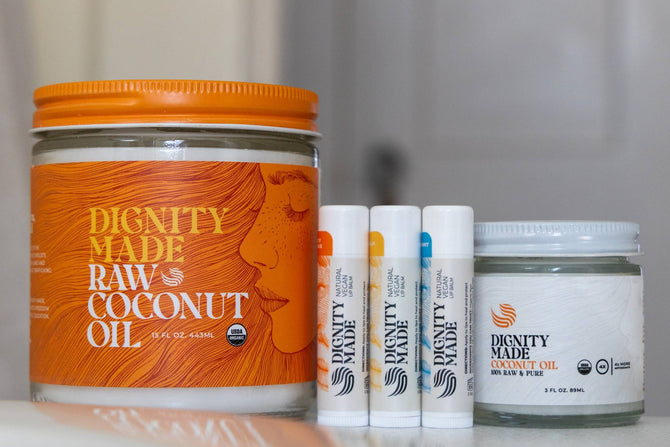
Dignity Made’s Raw Virgin Coconut Oil is crafted from fresh coconut meat and extracted raw using a centrifuge process, without heat or chemicals, to retain its natural micronutrients, antioxidants, and healing properties. Unlike many brands, even those labeled "cold-pressed," which often use dried coconut meat and heat during processing, this method ensures maximum purity.
The model goes beyond fair trade by practicing direct trade with farmers, eliminating middlemen and ensuring fair prices to address the debt trap at its source.

Key differences between the traditional commodity copra trade and Dignity Made’s direct whole-coconut sourcing ecosystem.
Restoring Dignity
Every jar represents a choice for better:
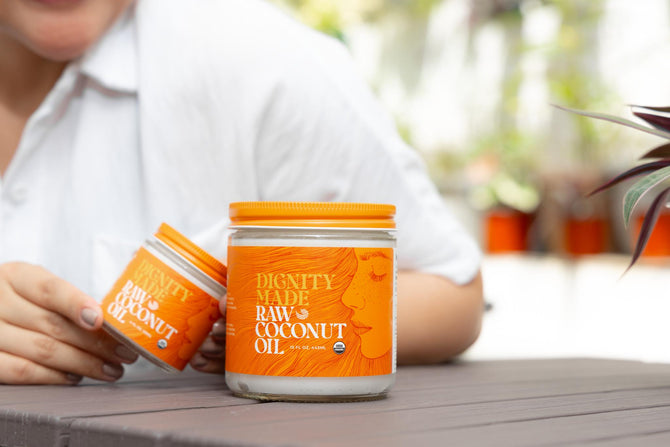
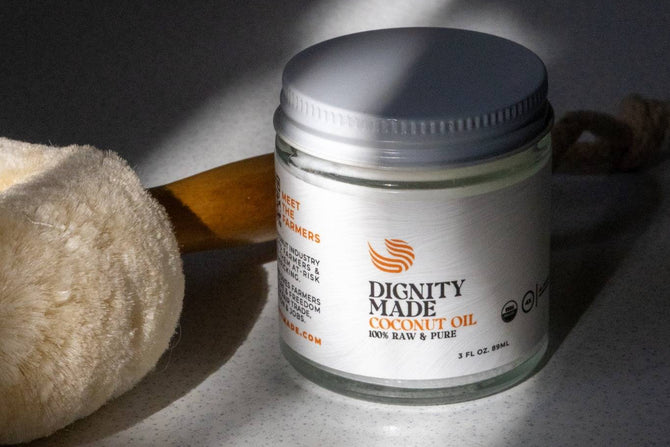
A Human Touch — Each jar is hand‑signed and traceable to the farmers who made it.
Restoring Dignity
Through direct trade, employment, clean water, education, and related support, 2,500 families have moved out of debt cycles. The model supports more than 100 jobs, clean water and education across more than 10 villages, and partnerships with over 150 farming families, many of whom are sending children to school for the first time.
Watch the Video: From Copra Slavery to Dignity
Virginia’s story, and the stories of millions of coconut farmers, comes to life in our short video, Copra Slavery Is Real. Meet the Family That Got Out. This film exposes the hidden costs of cheap coconut oil and shows how ethical purchasing can change lives.

Why Watch? "This isn’t just a story about coconut oil. It’s a story about human dignity, economic justice, and the power of your choice."
Shop Ethical Coconut Oil
Ready to make a difference? Switch to Dignity Made coconut oil today. Every jar you buy supports farming families, fights exploitation, and helps build a fairer world.
Shop NowFAQ: Ethical Coconut Oil and the Fight Against Exploitation
Q: What is copra slavery?
A: Copra slavery refers to the exploitative system in the coconut industry where farmers are trapped in debt bondage due to low prices for copra (dried coconut meat). Middlemen often control pricing, offer predatory loans, and force farmers into cycles of poverty, which can lead to forced labor or human trafficking.
Q: How is Dignity Made different from other coconut oil?
A: Most coconut oil is extracted from dried coconut meat using high heat, and is often neither organic nor fair trade. Dignity Made uses fresh coconuts, extracted raw through a centrifuge process with no heat or chemicals by delivering 4x more antioxidants and a clean, mild taste, while paying farmers fairly through direct trade.
Q: Is all coconut oil unethical?
A: No, but most conventional coconut oil is produced under exploitative conditions. Look for brands that:
- Pay farmers fairly
- Use whole coconuts (not copra).
- Provide transparency about their supply chain.
Q: How can I verify if a brand is ethical?
A: Ask the brand:
- Where does your coconut oil come from?
- How much do farmers earn?
- Do you work directly with farmers or through middlemen?
- Do you provide support beyond fair prices (e.g., loans, training)?
If they can’t answer these questions, they’re likely not ethical.
Q: What is the Palermo Protocol, and why does it matter?
A: The Palermo Protocol (2000) is the UN’s definition of human trafficking. It recognizes that trafficking isn’t just about kidnapping. It includes debt bondage, forced labor, and exploitation through coercion or fraud. This is critical for understanding how coconut farmers can be trapped in modern slavery.
Q: How does climate change affect coconut farmers?
A: Climate change increases the vulnerability of coconut farmers through:
- Typhoons and droughts that destroy harvests.
- Pests and diseases that reduce yields.
- Rising sea levels that threaten coastal coconut farms.
When farmers lose their crops, they’re forced into debt or migration, making them more vulnerable to exploitation (FAO, 2020).
References
- Coconut Community. (2023). Coconut Industry Outlook. Link
- FAO. (2020). The State of Food and Agriculture: Overcoming Water Challenges. Link
- Global Slavery Index. (2023). Global Estimates of Modern Slavery. Walk Free Foundation. Link
- OECD/FAO. (2026). Agricultural Outlook 2026-2035. Link
- Philippine Coconut Authority. (2023). Coconut Statistics 2023. Link
- U.S. Department of Labor. (2022). List of Goods Produced by Child Labor or Forced Labor. Link
- United Nations. (2000). Protocol to Prevent, Suppress and Punish Trafficking in Persons, Especially Women and Children. Link
- U.S. Department of Labor, ILAB. (2024). Supply Chain Study on Child Labor in the Coconut Industry of the Philippines. Link


