
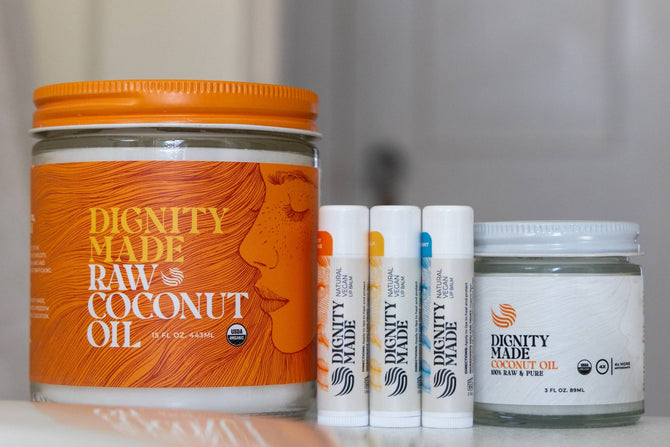
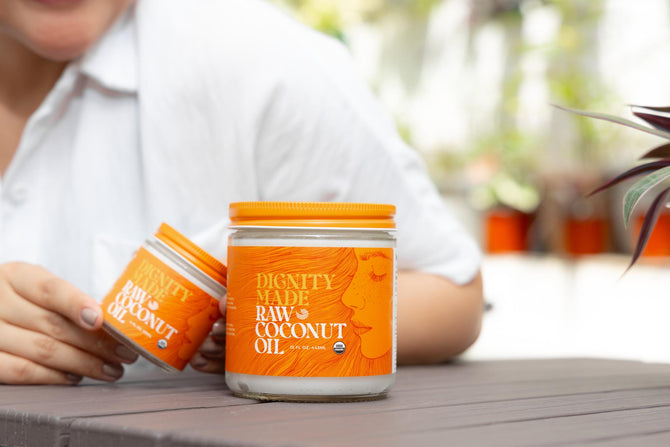
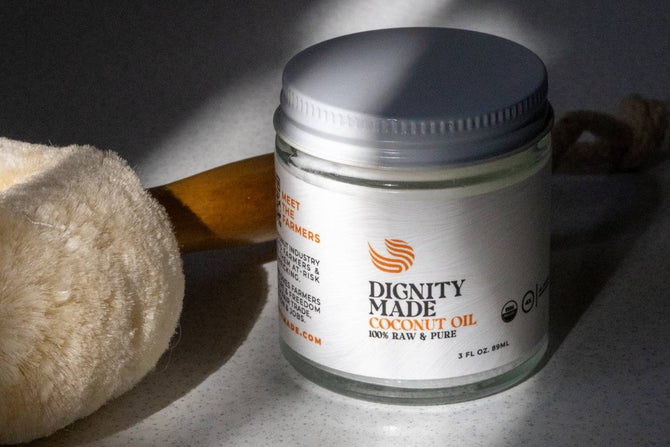
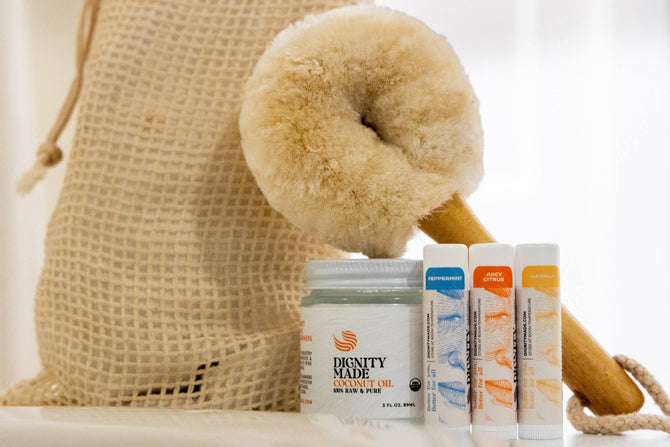

Every jar tells an economic story. Ours begins with farmers.
You probably don't think about poverty when you reach for coconut oil. You're more likely thinking about breakfast, dinner, a recipe, your skin, or the next step in your daily routine.
Long before that jar reaches your kitchen, a farmer has already done the work that makes it possible. A coconut begins on a farm, where it is grown and harvested, then moves through a network of buyers, processors, distributors, and retailers before becoming the product on a shelf. By the time you pick up a Dignity Made jar, dozens of hands have touched this. What lives are impacted, for better or worse, before it reaches your home? What stories can it tell from its journey?
But what happens along the way shapes economic opportunity.
The Part of the Supply Chain You Don't See
Who buys the harvest? Who determines the terms of that purchase? How much of the value created by the final product makes its way back to the people who grew the coconut? These are economic questions, but they are also questions about opportunity. For farming families, the relationships surrounding their work can influence whether that work simply provides income today or becomes part of something more stable over time.
That is one reason the International Day for the Eradication of Poverty matters beyond conversations about income alone. Poverty is often discussed in terms of what people lack, but economic opportunity is also shaped by the systems people participate in, the markets they can access, the terms available to them, and the relationships through which their work creates value.
By the time a product reaches a store or an online shopping cart, the person who produced its raw material can feel very far away from the person buying it. That distance matters because markets are not simply pathways through which products move. They are relationships through which value moves, too.
This does not mean farmers are helpless participants in the system. They are the people with the knowledge and skill to grow the crop in the first place. They understand their land, their harvests, and the realities of agricultural work in ways no distant buyer can replicate.
The question, then, is not how to save farmers from poverty.
It is how to build economic relationships that recognize the value of what they already do.
Why We Chose Direct Trade
Direct Trade is Dignity Made's approach to a more direct economic relationship with coconut farming families in the Philippines: more than 200 farming families today, across 30 villages, alongside 100+ jobs at our plant.
Behind those numbers is a woman named Virginia, a coconut farmer in the rural Philippines.
For years, she and her husband dried coconuts into copra and sold to middlemen at prices that barely kept the family afloat. When harvests failed, they often borrowed money just to get by. Most days, the family ate rice and beans. When their children got sick, there was little money for medical care.
Then Virginia chose to sell her whole coconuts to Dignity Made through Direct Trade at a fair price. The more reliable income helped her pay off debt that had accumulated through difficult seasons. It also meant she could stay with her family rather than seeking work abroad, as many Filipino parents do to support the people they love.
"Now we eat healthy meals," she says. "Our children are in school, and our home is full of laughter."
Every jar carries the signature of a farmer whose coconuts went into it, and Virginia's is one of them.
That relationship reaches further than one household.
Ivy Joy grew up in a coconut farming family living with that same uncertainty, wondering what a storm would do to that season's crop. When her parents started selling their whole coconuts to Dignity Made, it brought a sense of stability that helped make a different future possible.
Ivy finished high school and attended college, a rare opportunity where she's from. She earned a degree in Food Technology, spent time working in the city before returning home. Today, she is Dignity Made's plant manager, overseeing more than 60 people.
The idea behind Direct Trade is simple, even if the work behind it is not: know the people behind the product, build relationships with the communities that produce it, and create a purchasing relationship that goes beyond treating coconuts as an anonymous commodity.
We often describe that connection as "farm to jar." Not simply because it traces where a product comes from, but because it keeps the people behind it visible. Our coconut oil does not begin when a jar enters production. Its story begins with farmers like Virginia and Ivy's family.
And consistency matters. A farmer needs more than a single transaction to build a livelihood.
Keeping the Farmer at the Center
There is a tendency to tell stories about poverty by focusing on what people do not have. The result can be emotionally powerful, but it can also reduce people to their circumstances.
That is not the story we want to tell about Virginia.
She is not simply a woman who needed help. She is a farmer, a mother, and one of the people whose work makes our products possible. Her knowledge, labor, and decisions help create something customers around the world choose to buy.
That distinction matters.
When we talk about economic opportunity, we are not talking about giving dignity to people who somehow lack it. Dignity does not arrive with a paycheck, a purchase, or a charitable program. It was already there in the years Virginia spent working through typhoons and poor harvests to keep her family fed.
Economic opportunity can create more room for people to exercise that dignity: to make choices, support their families, invest in the future, and build stability through their own work.
Virginia put it simply:
"It's more than coconut oil. To us, it's freedom."
That is the kind of story Direct Trade allows us to tell.
It is not a story about a customer rescuing a farmer. It is a story about a farmer who produces something valuable, a business that chooses to build a relationship around that work, and a customer who chooses a product connected to that relationship.
Every Product Has an Economic Story
When you look at a jar of coconut oil, it's easy to think only about what the product does for you. Perhaps you cook with it. Perhaps it's part of your skin or hair routine. Perhaps it's simply a staple you keep in your kitchen.
Those uses are important. A product has to be useful and worth buying on its own.
But there is another layer to the purchase that is easy to miss.
Every product has an economic story behind it, and yours traces back to specific people. The coconuts in your jar came from farming families like Virginia's and Ivy's, in villages around our plant. The price on the shelf represents the end of that chain, but it does not tell you everything about the relationships that made the product possible.
When you choose Dignity Made, you choose a supply chain built around more than 200 farming families instead of an anonymous commodity market. When you buy it again, you help sustain the demand that keeps those relationships going.
What Your Jar Has to Do With Poverty
So what does all of this have to do with the International Day for the Eradication of Poverty?
It brings us back to economic opportunity.
If poverty is partly shaped by access to stable and meaningful economic opportunities, then the way goods are produced and purchased deserves a closer look. The markets people can access shape opportunity. The relationships within those markets do, too. And the ability to turn work into lasting value can make a meaningful difference, as it did for Virginia and as it did for Ivy's family.
Consumer products cannot replace the larger policies, institutions, and economic conditions that shape poverty. No single purchase can solve those challenges.
But our everyday economy still connects us to the people who participate in it.
A jar of coconut oil cannot carry the weight of solving poverty. It can, however, carry a story about economic relationships. It can remind us that behind the products we buy are people whose work creates their value. It can give us a reason to look beyond the label and ask where a product came from, who produced it, and what kind of relationship exists between the people at the beginning of the supply chain and the people at the end of it.
Sometimes, seeing that connection is where a more thoughtful choice begins.
Look Beyond the Label
We often encounter a product only at the end of its journey. The jar is sealed. The label is printed. The price is set.
The farmer who grew the coconut is thousands of miles and several steps away.
Direct Trade helps close some of that distance. It puts a farmer's name on every jar, and it is the security Ivy's parents earned for their family.
For Dignity Made, that means building relationships with coconut farming families and keeping those relationships connected to the products that reach your home. It means recognizing that the people behind the raw materials are not simply the first step in a supply chain. They are part of the story and part of the value.
That story is worth knowing.
Because once you know who grew the coconut, the jar looks a little different.
Look for the signature. It belongs to a farmer whose coconuts are inside.
Learn more about Direct Trade on our sourcing page.


